“Nếu bạn đã dịch câu này, bạn biết nhiều hơn chúng tôi lúc đó.”
The man continues speaking in Vietnamese while pointing to the bike. Sébastien looks at him. Then look at Matthew. Still no idea what he's trying to tell us.
He starts again, this time with his hands.
“Turn the bike around. I think he wants us to return the bike.”
A few minutes earlier, we were riding between two villages around Tam Coc when the mud and grass accumulated around the rear wheel of Sébastien's bike ended up blocking it completely. Impossible to move forward. We stop on the sidewalk that runs along the road. Around us, nothing but rice fields, on one side or the other. No house, almost no one, just this road which cuts the fields in two. This is where a Vietnamese couple aged just over 50 stopped to help us.
No words of English on their side, no Vietnamese on ours. The man inspects the wheel, then signals Sébastien to follow him to the edge of a rice field. With his hands, he collects water and begins to remove the mud. Matthieu arrives with an empty bottle. We fill it in the rice field, we pour, we turn the wheel, we start again. Bad location for the woman, placed just behind: her white sports t-shirt ends up covered in projections. A few rinses later, the wheel finally turns. Handshakes, big smiles and “cảm ơn” (thank you in Vietnamese). We will never really know what they told us. They probably don't either. But the bike left again.
It all started a few hours earlier, around 6:30 a.m., when we got off our sleeper bus which left Sapa eight hours before. Ultimately a pretty cool experience, even if sleep is a big word. We are awakened more by the regular screams of the driver than by the turns. As soon as we arrive, the heat is already there. We found a café to have breakfast and were even offered some fruit. Then head to our hotel, splendid, but obviously much too early to get the room. Fortunately, he lends bikes for free. A few minutes later, we are already driving towards the countryside.
And that’s probably how Tam Coc discovers himself best. By bike, the immense limestone formations appear even more imposing. They arise almost vertically in the middle of the rice fields, while small roads cross this large green plain between the reliefs. After a second coffee, we came across an activity that we didn’t yet know we needed: “duck therapy”. In a small café lost in the countryside, you just have to order a drink to be able to feed the ducks. Matthieu takes the experience very seriously. He ends up lying in their enclosure, covered in seeds, with an army of ducks climbing on him. He could probably spend the afternoon there.
We still end up heading back towards the famous Dragon Hills. We were more likely to imagine a quiet hike in the middle of nature. We discover a paid site, very well laid out and full of places designed to take photos. Everywhere, visitors stop in front of the most scenic viewpoints and installations. With the heat, the sun and the crowds, the experience becomes almost unpleasant at times. The contrast is striking: all around, the reliefs and rice fields are magnificent, but above all we want to find the quieter little roads. Ironically, it is precisely on the way back that the mud, a stuck bike and two strangers will create the best memory of the day.
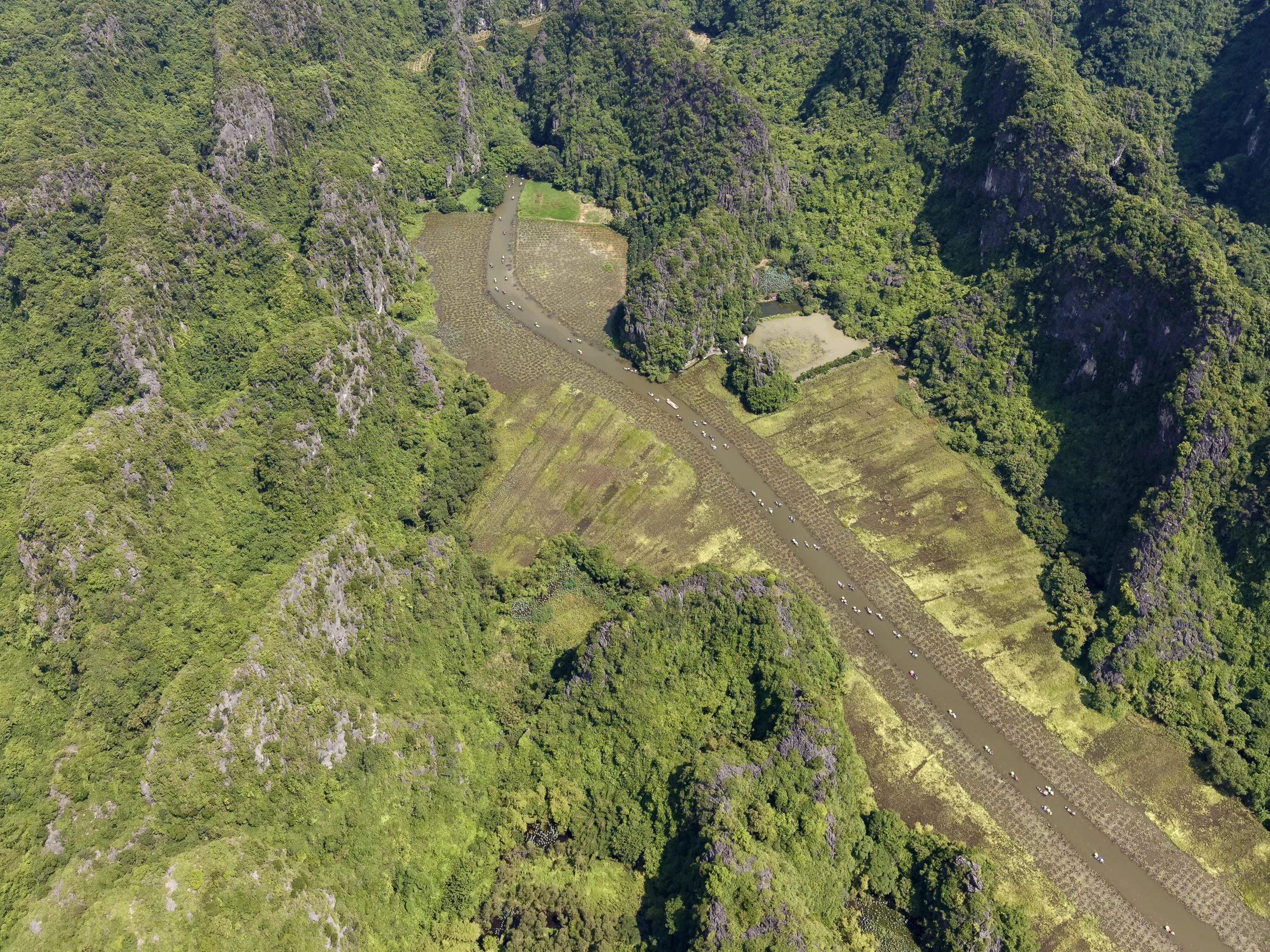
The next day, we completely change perspective with Trang An. Here, the water meanders between immense limestone cliffs covered with vegetation. We choose the end of the day, when the heat begins to subside, for around three hours on the water. And our attempt to meet a few backpackers fails once again: a Vietnamese grandmother and great-grandmother take their place in our boat. The rest of their family, parents and two children, are sailing right next to it. We share very few words, but the two boats end up moving forward together.
Our rower, very kind and quite funny, takes us quietly between the rock walls and through the caves which cross certain mountains. Inside, the light disappears, the ceiling gets closer, then a few moments later we emerge into a new valley surrounded by cliffs. At the stops, the two ladies had some difficulty getting in and out of the boats, so everyone helped as best they could. The father too, with varying success since he even ends up in the water trying to help the grandmother. The caves are splendid, the temperature more pleasant and, despite the three hours of paddling at a leisurely pace, you don't really see the time passing.
We also rent a scooter to explore the region further and spend an evening in Ninh Binh. At nightfall, the illuminated buildings and temples are reflected in the water and completely transform the scenery. The whole thing is very scenographic and quite recent, but visually, it works perfectly. The lights outline the roofs and facades in the night while their reflections extend onto the water. We drink a juice, take some drone images and simply enjoy the scenery before going home.
The rest of the stay takes a much calmer pace. Tam Coc is not really the kingdom of nightlife, so we take advantage of our hotel and especially its swimming pool when the heat becomes too much. And small victory: we also find a large, rather nice gym. Two days in a row, we took the opportunity to find some weights and machines in the middle of the trip.
So, what do we remember about Tam Coc? Of course, these immense cliffs which emerge in the middle of the rice fields, the small roads perfect for cycling and the rivers of Trang An which disappear under the mountains before reappearing in another valley. But our best memories are ultimately the most improbable: Matthew lying under an army of ducks, a Vietnamese father who ends up in the water while trying to help his family, or two strangers who stop at the edge of a rice field to unblock our bike without us managing to exchange a single real sentence. We came to Tam Coc for its landscapes. We left with, in addition, some scenes that no itinerary could have predicted.