“Ah, there, he’s putting on his pants.”
We watch the man calmly cross the small restaurant. He gets back to his scooter, picks up a pair of pants from a chair and puts them on by the side of the road. A few minutes earlier, he was still in his boxers.
“I think he’s definitely going to go buy the eggs.”
We had just ordered two omelettes.
Around us, almost nothing. A small road crosses the countryside around Phong Nha, between fields, a few almost empty restaurants and large mountains covered with vegetation that close the horizon. Not a tourist. His wife took our order with very little English and a lot of “OK, OK, OK”. A response that we hear everywhere in Vietnam and which always gives the impression, for a few seconds, that everything is perfectly clear.
Then doubt sets in.
Because here, an “OK” can mean “I understand”, but sometimes also “I think I understand” or simply “we’ll see”. A few minutes later, the scooter returns. On the handlebars, a bag full of eggs. The man hands it to his wife. This time, at least, the “OK” really meant omelette.
To understand how we found ourselves there, waiting for our breakfast while watching our cook return with the ingredients, we have to go back to the morning before. We rent two bikes and set off to explore the surroundings of Phong Nha. Very quickly, buildings became rarer. The road follows the river then plunges into the countryside of the Bồng Lai sector, between rice fields, small villages and limestone reliefs which emerge behind the fields. A few buffaloes, a roadside café, impromptu stops to look at the landscape. For several hours, we simply move forward to the rhythm of the pedal strokes. After the cities and major tourist sites, finding these almost empty roads feels great.
In the afternoon, head to Phong Nha Cave. The adventure begins before even seeing the cave. On the dock, the price of the boat is fixed, whether it carries two people or is almost full. So everyone discreetly observes the new arrivals, hoping to find companions with whom to share the costs. A few minutes are enough. A small group is formed, the calculations are made and there are finally seven of us on board.
The boat goes slowly up the Son River. The vegetation runs along the banks, the limestone mountains come closer, then an immense dark opening appears at the foot of one of them. At the entrance to Phong Nha Cave, the engine stops and the boat glides almost silently under the rock. Daylight disappears behind us. The vault rises very high above the water, then descends, widens and changes shape again. The lighting reveals sculpted walls, stalactites and limestone formations that seem to gradually appear in the darkness. Despite the boats following the same route, the cave seems immense. Part of the visit then continues on foot, among the rock concretions. We came thinking of discovering “the tourist cave of Phong Nha”. We are already very impressed.
And yet, the next day, Paradise Cave completely changes scale again.
It is precisely on the road that leads there that our omelette story takes place. Once satisfied, we take the road back to the site. From there, you still have to reach the cave. Small electric carts transport those who prefer to avoid part of the journey. We choose to walk.
And the approach alone is already worth it.
The path passes through a dense forest, surrounded by vegetation, before starting to climb towards the entrance to the cave. We walk under the trees, far from the road and the noise, then the slope becomes steeper. After the bike ride the day before and the small country roads, we still find this feeling of being surrounded by greenery and mountains. The arrival is somewhat deserved. And at that moment, we especially say to ourselves that after Phong Nha Cave the day before, it will be difficult to do much better.
We were absolutely not ready for what was behind the entrance.
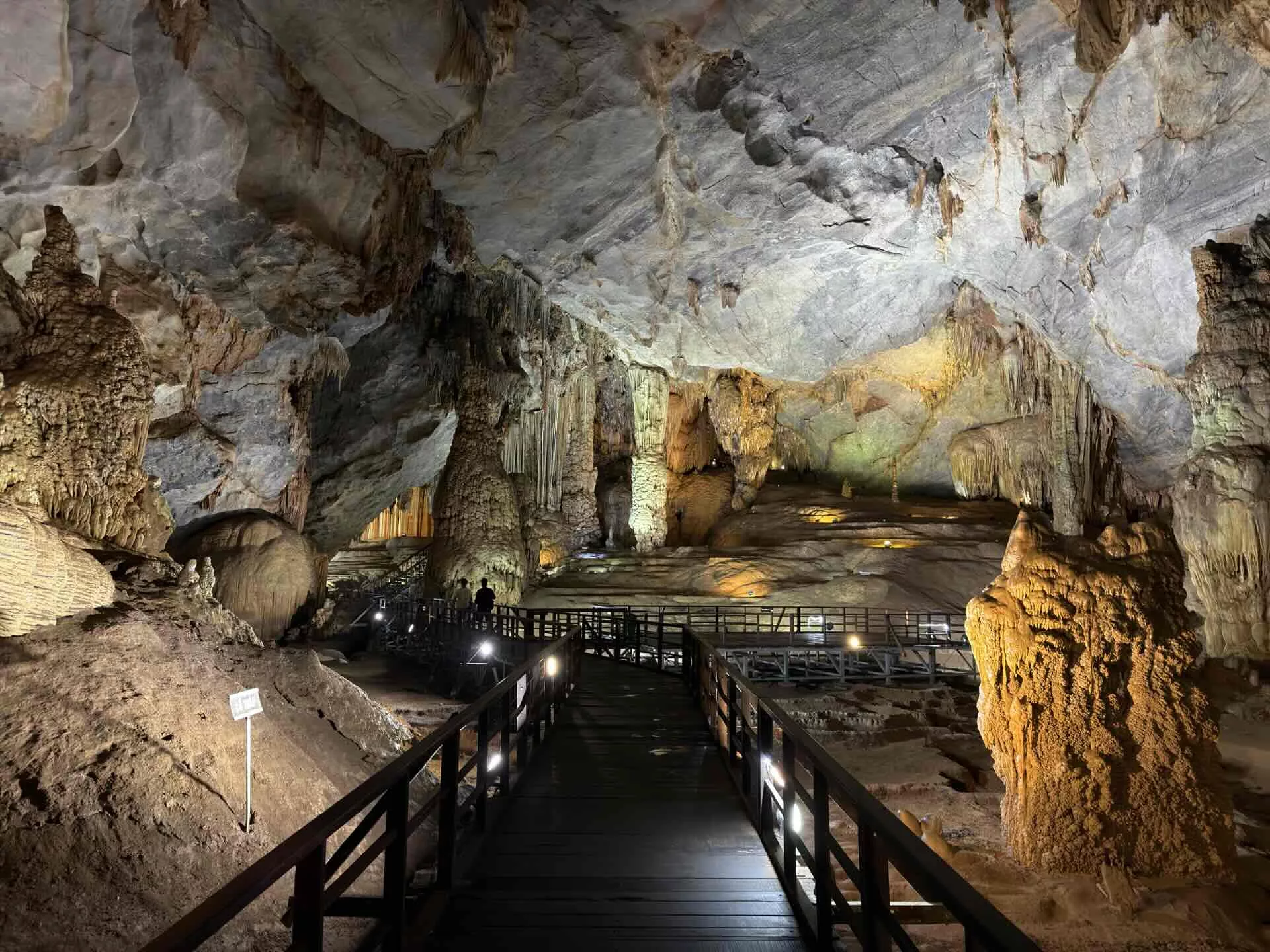
We start to descend and, almost immediately, space opens up. The cave seems disproportionate. A long wooden footbridge leads into a succession of gigantic rooms whose boundaries are sometimes difficult to distinguish. The ceiling is so high that it is difficult for the eye to judge distances. Huge stalactites descend from the vault, thick columns connect the floor to the ceiling and layers of limestone seem to have flowed down the walls before freezing.
And very quickly, we almost no longer feel like we are under a mountain.
The setting looks more like that of a science fiction film. At times, you could almost believe yourself in an episode of Star Trek, landing on a planet whose reliefs have been carved in stone. Some formations resemble organic structures, others like completely alien mineral landscapes. The lighting makes a wall appear in the darkness, then another disappears a few meters further. We obviously know that we are still under Phong Nha. Visually, however, we have the impression of having changed the world.
We are moving slowly. Not really by choice. Every few meters something stops us.
A training course takes up an entire wall. Further on, a column seems almost ordinary until a person walks by and finally gives a sense of its scale. Some concretions look like waterfalls of stone, others form folds, points or enormous masses frozen in the darkness. The light reveals the volumes just enough for us to understand their immensity, then the footbridge continues and a new room appears.
And this is probably what strikes us the most: the photos are incapable of telling the size of Paradise Cave. You can photograph a stalactite, a wall, a detail. But as soon as you try to grasp the whole thing, everything seems smaller on the screen. You miss the sensation of having tens of meters of rock above your head, of seeing the footbridge become tiny in front of you and above all this almost unreal impression of moving forward in a setting that seems to belong to another planet.
We spend more than an hour there walking, looking, going back a few meters, taking photos and trying once again to show the proportions. The day before, Phong Nha Cave had already seemed exceptional to us. Paradise Cave is simply grandiose. This is without hesitation the highlight of our stay.
The last day, we had to finish with Dark Cave, known for its more adventurous side, its passages in the water and its experience closer to caving. When we arrived, almost no one. For a few seconds, you think you've found the right moment. Misinterpretation: the cave is closed due to river conditions. This time, no plan B. We're leaving again.
So, what was this madness under the mountain?
Difficult to explain without being there. Phong Nha Cave had already impressed us, but Paradise Cave gave us the impression for more than an hour that we had left Vietnam and entered a science fiction setting. And yet, this stay is not just about what is underground.
We also liked Phong Nha for everything there is around it. The bikes along the river, the almost empty small roads, the countryside, the restaurants where we go to buy eggs after ordering and these mountains covered with vegetation which remain constantly in the background. A calmer, more remote atmosphere, which completely changes from the rhythm of big cities and the busiest sites.
We thought we would make Phong Nha a small stopover before hitting the road again. Ultimately, even without Dark Cave, the few days spent here were well worth the detour. Just to enter under this mountain and have, for a few moments, the impression of having changed planets.