In front of us, the traffic in Hué looks like a steady stream of scooters. An hour earlier, we were leisurely sipping coffee at a huge intersection, fascinated by the way the motorcycles pass each other and weave in and out without ever really stopping. Now that we’re on our own scooter in the middle of the flow, the experience is different. Here, the horn seems almost like part of the traffic rules. You honk to signal your arrival, to pass, or to make your way through. We’d already ridden through the Vietnamese countryside, among rice paddies and villages. In a big city like Hué, it’s a whole different story.
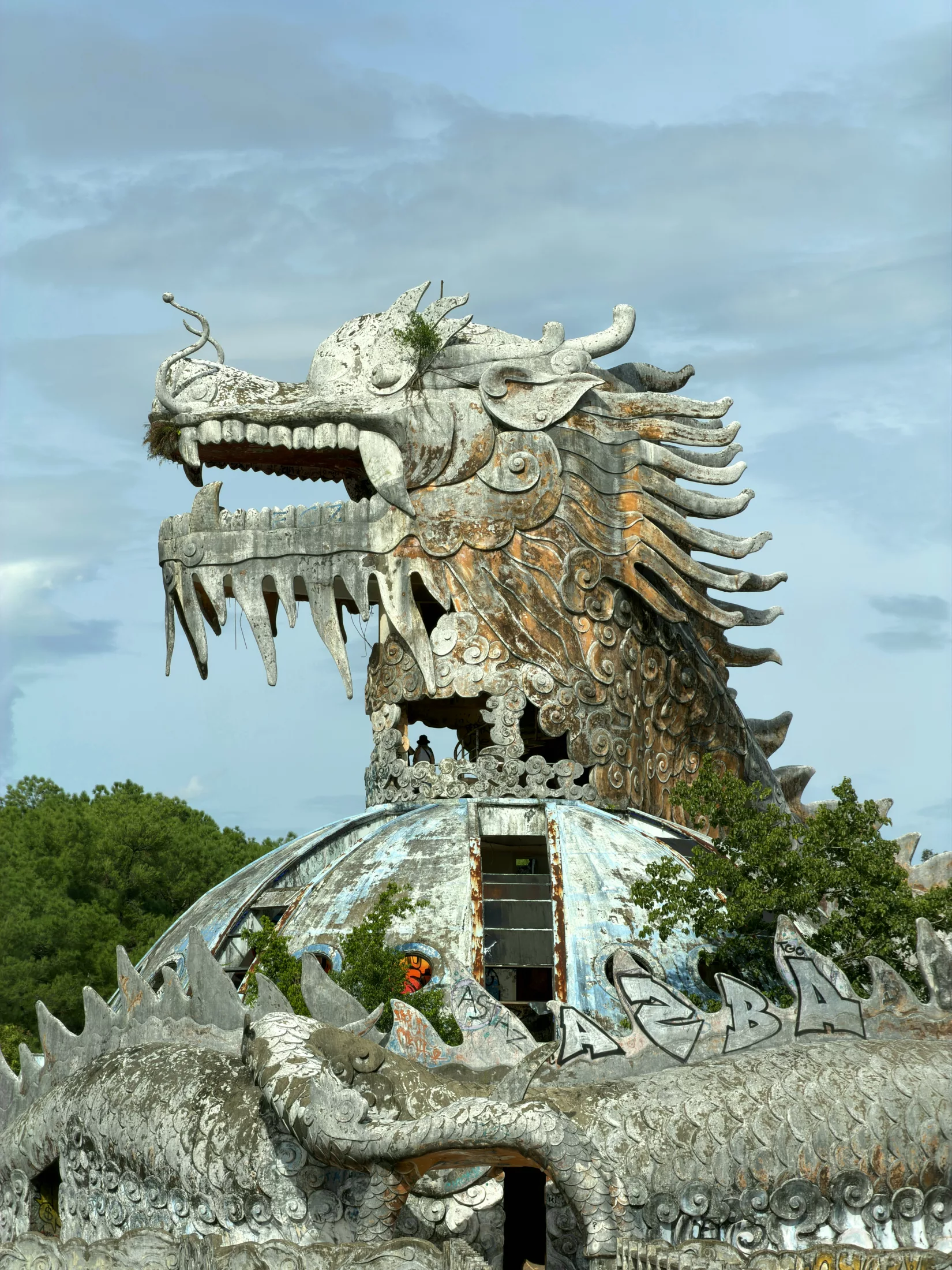
That morning, we set out from the city center to head for the hills where the former emperors are buried. For nearly a century and a half, Huế served as the capital of Vietnam under the Nguyễn dynasty—the country’s last imperial dynasty—from 1802 to 1945. Palaces, tombs, and pagodas bear witness to this history. Yet ever since our arrival, there’s also been talk of this old, abandoned dragon hidden amid the vegetation. And we’re starting to wonder if our fondest memory of Hué will truly be the one history had in store for us.
The day before, we start with the most obvious attraction: the Imperial City. Behind the moat and thick walls lie a succession of monumental gates, ceremonial courtyards, pavilions with sloping roofs, temples, and gardens. Built beginning in the early 19th century, it became the political and ceremonial heart of the Nguyễn dynasty. Some of the buildings were destroyed during the wars, while others have been restored or rebuilt. This sometimes gives the strange impression of walking through an ancient site where certain parts seem almost new. For nearly three hours, you wander from one courtyard to the next, trying to imagine what this immense city-within-a-city was like when it still housed the imperial court.
At the end of the day, we head up to a hotel rooftop. Below us, the Perfume River flows through Hué, while the mountains frame the horizon. The sun sets, and the first lights come on around the ancient city. Then it’s time to eat. We order hến xúc bánh đa, small clams served with herbs, peanuts, and crispy rice crackers. One dish arrives. Then another. Then the drinks. Thirty minutes later, we realize that one of our meals simply had never been prepared. Yet plenty of “OK, OK” had been exchanged, which reminds us of a few other conversations in Vietnamese restaurants where we also thought everything was perfectly clear. Hué has just confirmed that this isn’t necessarily the case.
And Hué has another attraction in store for us—one that’s far less imperial but almost as exciting at this point in the trip: a real supermarket. After several weeks of shopping almost exclusively at convenience stores, coming across dozens of aisles suddenly feels like a big event. We clearly fall into that category of travelers who treat a foreign supermarket like a museum. We inspect the fruits, the fresh produce, the beverages, and then we come to the canned tuna section. And that’s when the visit takes a much more serious turn. Yes, even while traveling, we’re always on the hunt for lean protein. And no, we’re not particularly proud of the time we spent in front of the canned goods section, translating the labels on the tuna cans one by one to find the one packed in water, without oil, and with the best protein-to-fat ratio. After several weeks of traveling, our interests have clearly shifted: in Hué, we marvel at the imperial palaces, the abandoned dragons… and a can of oil-free tuna.
The next day, our scooter took us first to the Minh Mạng Mausoleum. The imperial tombs of Huế are much more than mere burial sites. The rulers conceived them as vast complexes where buildings, ponds, gardens, and hills come together to form an entire landscape centered around their memory. Minh Mạng’s complex is organized along a long axis: a gate, a courtyard, a pavilion, a pond, a bridge, and then the vegetation that gradually closes in on the view until it reaches the hill where the tomb stands. Everything is symmetrical, serene, and surprisingly integrated into nature.
A few kilometers further on, Khải Định takes a completely different turn. His mausoleum climbs up the side of a hill via a series of staircases and terraces. Built in the early 20th century, it dates from a time when European and French influences blended with Vietnamese architecture. The exterior, dark and massive, gives absolutely no hint of what awaits us inside. Glass and porcelain mosaics cover the walls and ceilings in an almost extravagant profusion of colors and details. After the serenity of Minh Mạng, the contrast is striking.
And that's where we completely leave the imperial narrative behind.
A few kilometers from downtown lies an old, abandoned water park. We leave the scooter behind and continue by bike along a small road winding through the trees. Little by little, empty pools, deserted bleachers, and slides that no longer lead anywhere come into view. Then, in the middle of a lake, the dragon looms into view.
The immense concrete creature still towers over the water. Originally, its structure housed, among other things, an aquarium. Today, its scales are covered in graffiti, its openings gape wide, and vegetation is gradually encroaching on the area around it. You enter its body and climb all the way up into its mouth. After the perfectly preserved views of the tombs and the restored courtyards of the imperial city, the contrast is almost absurd. Here, people no longer come to see what the place was meant to be. They come to see what it has become.
Before leaving Hué, we finally reach the Thiên Mụ Pagoda, known as the Pagoda of the Celestial Lady, perched on a hill overlooking the Perfume River. Even before we spot the monks, we hear children’s voices. A group is taking part in a celebration and singing somewhere within the pagoda grounds. Let’s just say that not all the notes seem to be coming from exactly the same spot. Their singing accompanies us as we cross the courtyards, and the scene brings a much livelier atmosphere to this final visit. In front of the octagonal tower overlooking the river, Hué suddenly takes on a much calmer pace.
So, did this abandoned dragon manage to dethrone the emperors of Hué?
Not entirely. The Imperial Tombs remain among the most beautiful sights to be found here, and the Imperial City, with its colorful pavilions, vast courtyards, and monumental gates, is still a must-see. But let’s be honest: it’s a lot of fun to explore this old, deserted water park, to see the dragon rising from the middle of the lake, to walk inside its body, and to climb all the way up into its mouth.
We’d actually never really done any urban exploration before. After this experience, we understand a little better the fascination with these abandoned places, frozen in time and gradually being reclaimed by vegetation. And if anyone ever asks us what to visit in Hué, we’ll of course tell them about the tombs and the Imperial City, but we’ll also recommend without hesitation that they go in search of this old water park. Because the experience is truly one of a kind.
Perhaps it is precisely this contrast that we find so appealing in Hué. In the morning, we walk among the emperors’ tombs, built to stand the test of time. A few hours later, we climb into the mouth of a concrete dragon, in the middle of a water park that no one could have imagined would become so fascinating once it was abandoned.
So no, the dragon hasn't quite dethroned the emperors. But it has clearly stolen some of their limelight.